
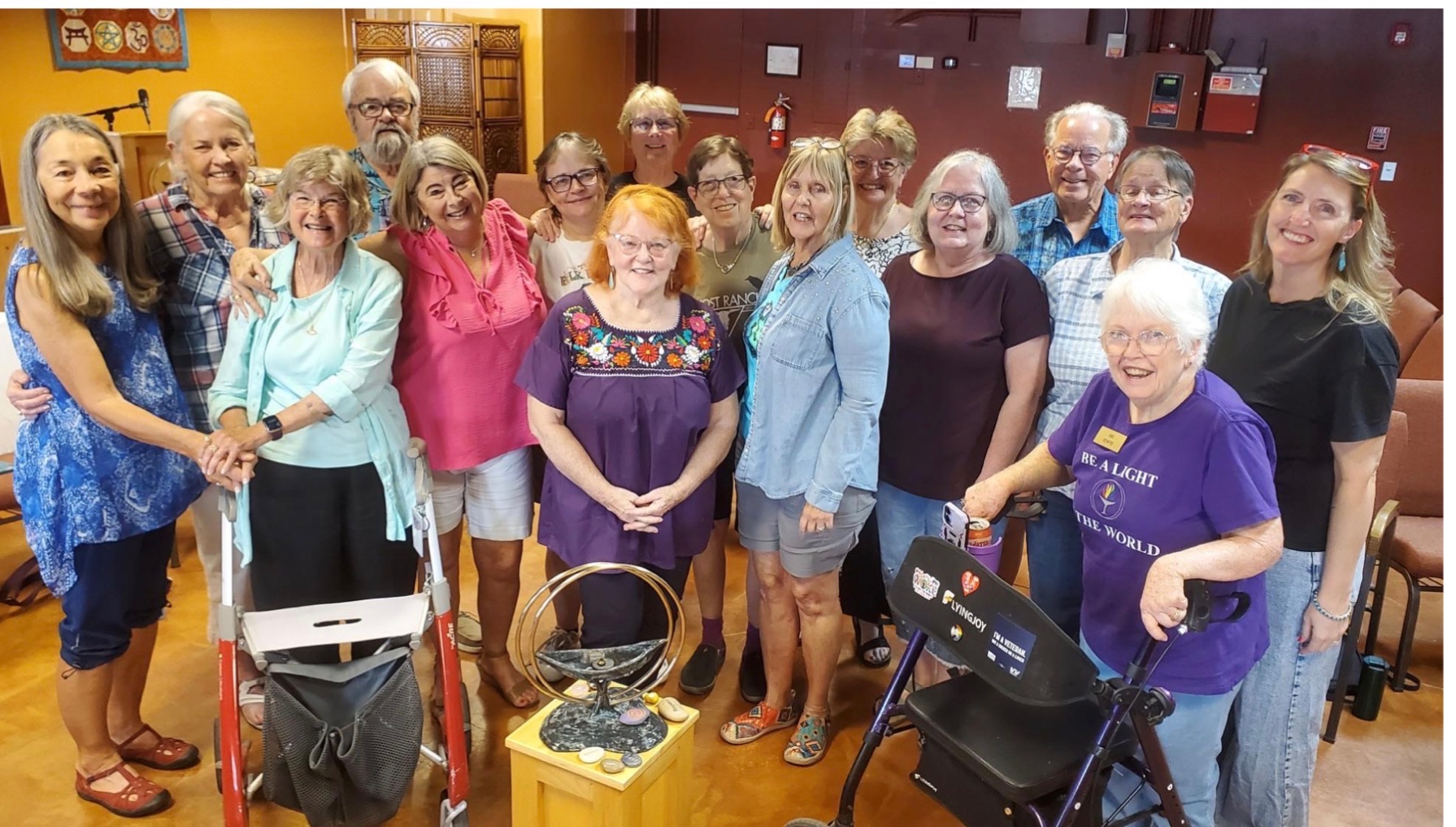
Rev. Samantha Wilson's Connections Project.
Letter from Rev. Sam about the Opening Phase:
Hello BUU!
I am happy to bring you my reflections from our first phase of work together in this newsletter, offer my gratitude for our time, and name some next steps.
In May 2025, your Board and minister, in consultation with leaders in the congregation, invited me for an initial phase with you to listen as an outside witness. The invitation was to listen in order to…
- Create clarity among leaders about varying levels of conflict and hurt
- Identify needs being expressed for processes or support
- Propose some possible pathways forward in the 2025-2026 church year
After over 30 one-to-ones, several email exchanges, and support from your leadership and Listening Team, I have drafted a video for you of my reflections from this time together. This includes some of my thinking about approaches to this work, core themes and requests from my conversations with you, and a possible pathway for next year.
You can view the video presentation by clicking here.
The video is an hour, and covers the following topics:
- Introduction to Conflict Engagement Systems and Organizational Systems
- BUU Themes:
- Context
- Grief and Healing
- Relationships
- Structures
- BUU Requests:
- Trustworthy Listening
- Grief, Healing, and Accountability
- Covenant, Intimacy, and Relationship
- Structural Clarity
- Potential Pathway for 2025-2026: Focus on Relationships
After you view the video, your leadership welcomes your personal reflections at this survey here. All questions are optional and can be answered in brief or in depth and will be shared with the Board, the Listening Team, Rev. Inge and me.
You will hear more from your Board leadership in August and September with next steps. I am grateful for this period of time with you and looking forward to your reflections. I wish you a summer of connection, care – and some cool! – wherever you are.
With care,
Rev. Sam
BUU Restorative Practices Consultation
“Strengthening Relationships”
December 2025 - June 2026
Rev. Sam Wilson
Introduction
In Spring of 2025, your Board and minister invited me to accompany you through a time of community disconnection and disagreement. A conflict surrounding a decision and interaction between Board leaders, your minister, and a long-time, elder congregant, had disrupted what was already a tentativetrust between congregants and one another, the Board, and the minister. Some people felt close to this conflict and knew the pain points in detail, while other members of the community felt no clarity about what had occurred. There was a desire to find a way forward, but uncertainty about where to begin. Your Board and minister contracted to work with me, with the support of a “Listening Team” that would assist me in making connections and meaning of what congregants were experiencing.
I began with one-to-one listening to over 30 individual congregants, including additional conversationsvia email. We held an in-person and virtual Town Hall for an introduction of my work and additional reflections or questions from the community. I met several times with the minister to offer support and coaching on the dynamics they were experiencing. I supported dialogues between congregants and the minister to attend to disconnections in real time.
At the end of that time and in dialogue with the Listening Team members, I shared the themes and topics I heard discussed and named several priorities for next steps. The full presentation is available here. I identified what I heard as primary “community requests” from the listening as follows:
Community Requests (Gathered from April 2025 - Listening Process)
● Trustworthy Listening
- Trustworthy space for sharing our pain and needs
- A place we can direct one another to share and receive
- A process in which multiple experiences, truths, needs, could all exist
● Grief, Healing, and Accountability
- Place to acknowledge what has been hard or painful; name mistakes and try again
- Relationship repair between congregants, leaders, and minister
- Ways to name history, share the stories and information, and ritualize/release together
● Covenant, Intimacy, and Relationship
- Actionable agreements and covenant: How do we become the people we want to be?
- Commit to knowing more of each other, intentionally
- Support fun and the depth: small group ministries, groups, gathering, eating, singing.
● Structural Clarity
- Honest, trustworthy conversations about current structures and the congregation. Especially…
- Communication and Information
- Financial and Resource Engagement
- Office of Ministry
- Purpose Discernment - How do we come to what is most important to us?
Congregational leaders reached out to me in the Fall of 2025 to begin drafting a second stage of consultative work.
The original request was for some kind of group coaching and skill development process, dovetailed with the recently updated Right Relations Policy Trifold. In collaboration with congregational leaders, Idrafted a proposal for a learning “cohort,” and included additional hours for direct coaching and consultation support with the Board and minister. After several rounds of edits and dialogue with thecongregational Board (including a community vote to assess support of the project,) the proposal was accepted in December of 2026 and our next season of work began.
2026 Group Coaching and Skill Development: “The BUU Connections Team”
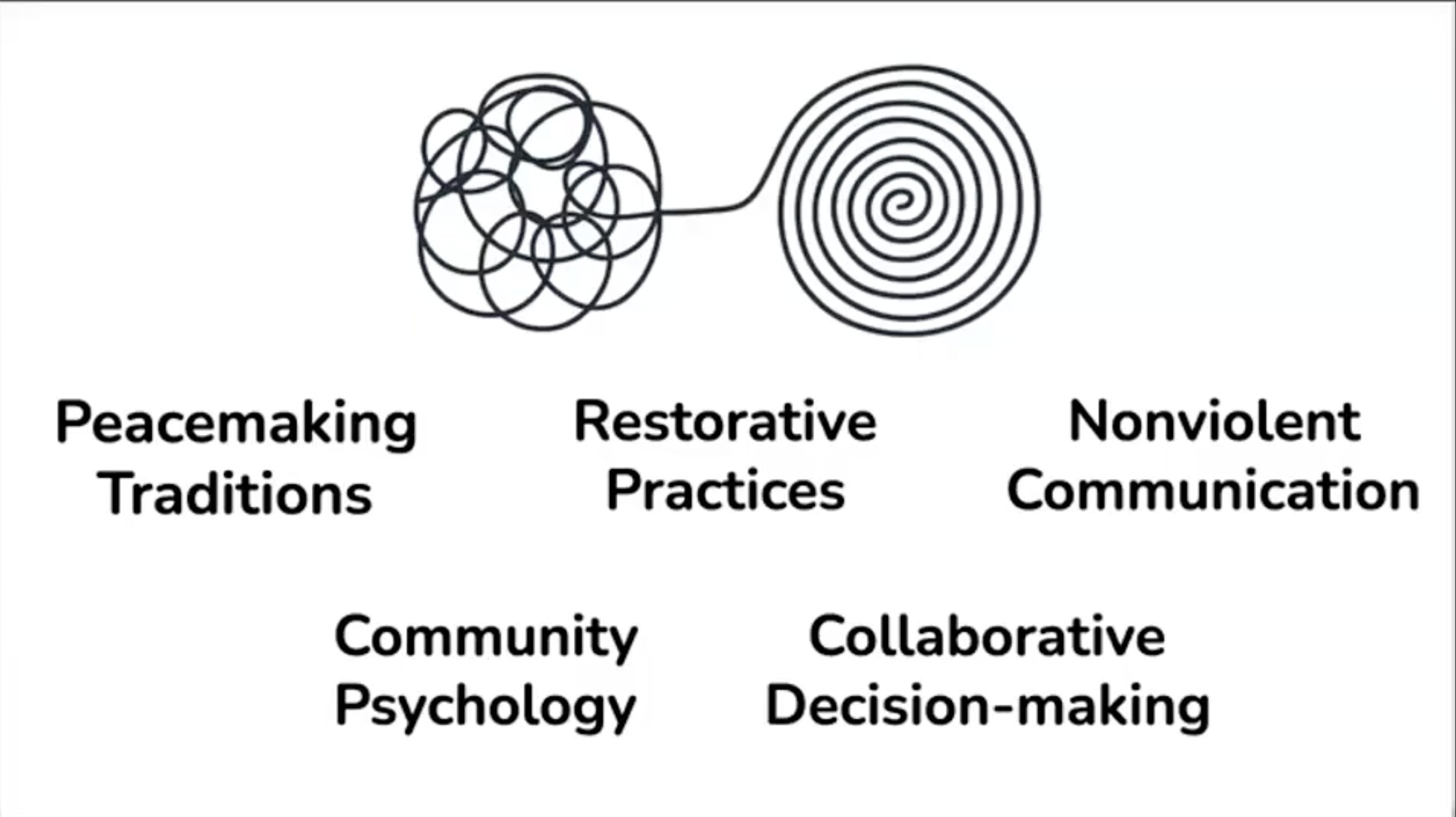
In December of 2025, we invited congregants to join the “Connections Team” – a group to consist of up to 20 leaders committed to gathering together in shared learning to strengthen community trust. The program was inspired by lessons from restorative practices, trauma and resilience training, andcommunity psychology. This included time in large groups in-person and online, as well as small groupengagement. The invitation to the program was made publicly, and included some leaders encouragingone another to apply more directly. The team included an initial registration list of 21 participants, with 17 completing the full program.
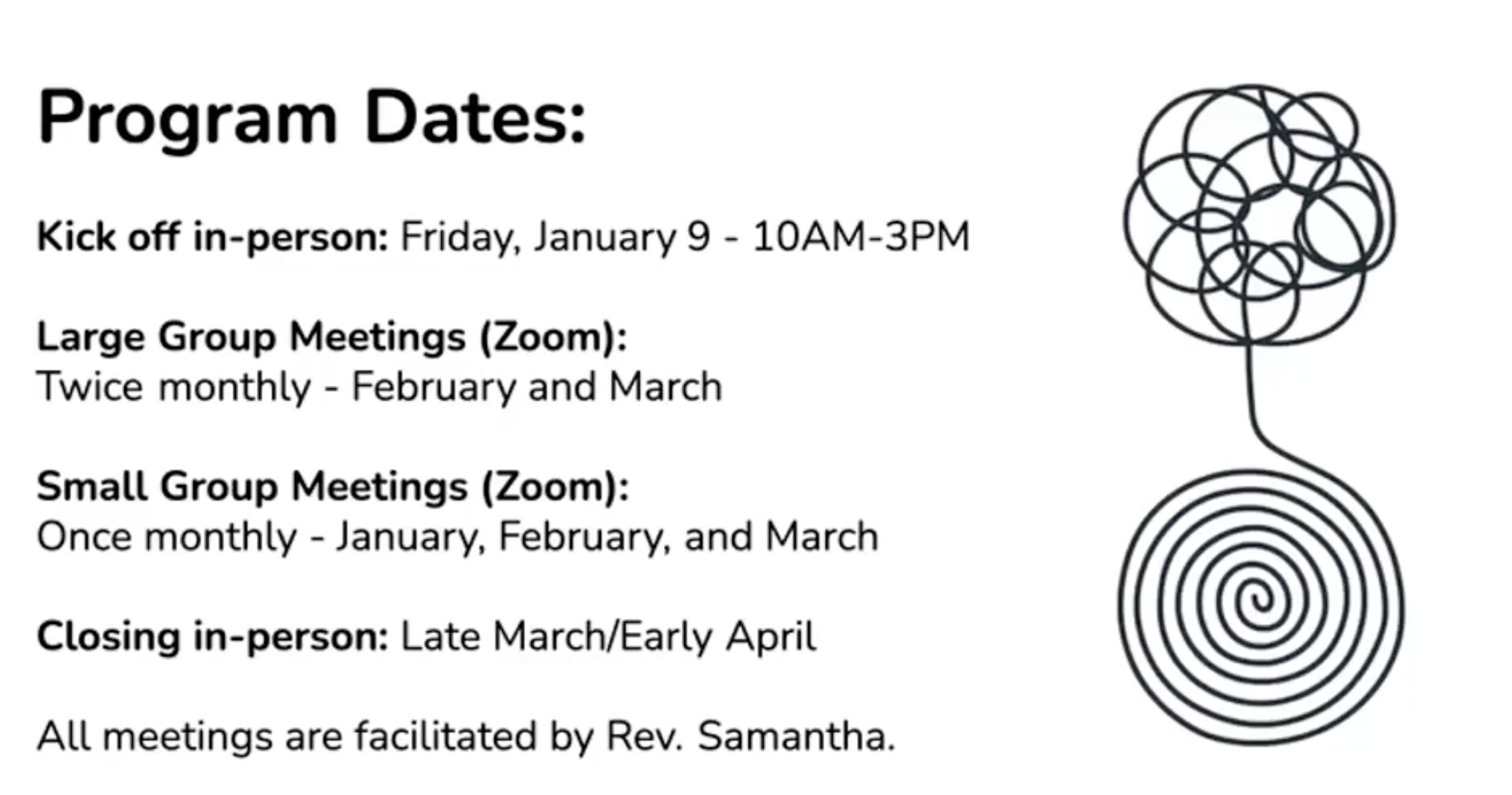
The team met as a Large Group three times in-person, three times on Zoom, and facilitated a closing worship followed by a Community “Talk Back” Circle.
- In-person Kick Off - Friday, January 9 - 10AM-3PM at BUU
- Session 1 - Getting to the Heart of It - Feb 5, 10-11:30AM (Zoom)
- Session 2 - Acknowledgment without Abandonment - Feb 19, 10-11:30AM (Zoom)
- Session 3 - Fishbowl - March 6 - 12:30-2:30PM (In-person at BUU)
- Session 4 - Tracking Patterns - March 19 - 10AM-11:30AM (Zoom)
- In-Person Closing - Friday, March 27- 10AM-3PM at BUU
- Connections Team Sunday Service and Circle - Sunday, March 29 at BUU
In between Large Group sessions, participants were also placed into “Small Groups” – groups specifically designed to encourage new connections and tend relationships. At the start of the Connections program, individuals were asked to acknowledge where they already felt trust in members of the large group, where they were interested in growing new relationships, and where trust feltstrained. Small Groups combined people across different experiences, trust levels, and relationships to create opportunities for vulnerability across “groups” in the congregation. Each Small Group was facilitated by Rev. Samantha. Each Small Group met three times over two to three months.
The key pillars of the overall program included: (1) self and co-regulation, (2) naming the heart of one’s own experience, (3) listening to another’s experience with curiosity and compassion, and (4) noticing community patterns that contribute to disconnection at BUU.
- Self and Co-Regulation: Participants were invited to track their nervous system stress response at BUU over a month, including a weekly optional “reflection” assignment designed to notice their feeling in response to stress. Each session included time to practice noticing and tending our stress response.
● Naming One’s Own Experience and Listening to Another:
- Inspired by non-violent communication and restorative practices, participants were invitedto do homework that included journaling about as well as meeting with a partner in their Small Group to share about their own conflict histories, as well as share a time when they caused hurt or harm in the congregation.
- We held an in-person “fishbowl” in which a few participants prepared in advance to share about a recent conflict event (the activating event from Spring of 2025) and theirexperience of it, while listening to others share a different experience of the same event. Each participant practiced reflecting back the “heart” of what they heard as the larger group served as witnesses to their process. The focus of the group was on cultivating understanding of one another, not agreement.
- Noticing Congregational Patterns that Contribute to Disconnection: Informed by the experiences shared in our fishbowl, Rev. Samantha drafted a sample “pattern” to describe theexperience of disconnection in the In our final sessions, we acted the pattern out (with our bodies) to more clearly see the chain of actions and reactions that create the disconnects. (This graphic and explanation of the pattern is included in the appendix of this document.)
In our final gathering together, participants reflected on the impact of the program. They were invited to share what they thought was most important to remember in taking the next step as congregants or as leaders in the community, especially if a program or effort similar to this one continued into next year.
Most important ingredients of the Connections Team work:
- Presence, process, an excuse to come together to do relational work
- Personal willingness to listen deeply to each other
- Safety, honesty, compassion, curiosity to shift what we could
- Repeated and ongoing gatherings that create cohesion
- Accessibility
- Small groups on Zoom that are well-moderated
- Facilitation that creates the opportunity– structure, lesson plans, small groups (a moderator with trust and humor)
- Listening to other people differently and feeling other people also listening differently: “It felt like a frozen river that starts to break apart as it gets warmer. Trusting it to get us tospring, but we can not rush Yet the river has been running beneath what was frozen the whole time.”
- Success is a sense of loosening between us and within us
- Learning the importance of the whole congregation: how much we value it and each other, we begin to reduce our harshness and monitor our tone to reflect the valuing.
- Thinking before opening our mouths! Acting but not Thinking about tone.Looking at everyone with love and compassion. Listening.
- Having time and space dedicated to listening and getting to know others that we rarely speak to, the importance of compassionate listening.
- Appreciating finally, really, seeing each other – going past our stereotypes of each other.
- Giving time to explore different
- Being open ourselves – we could do this because we made it
- Holding each other in gentle, positive
- The exercise on reflecting on a time when we have done harm to others – it was a difficult but important activity.
- Moving towards a regular practice of
- We don’t actually understand reactions unless we explore
- We can be ambassadors to listen to other people’s experiences – from hearing comes understanding comes a way of forward.
- Sometimes when it’s really hard in a family, you get professional We sought this out, but not sure if we had the whole congregation on board.
- “It breaks my heart that we can’t be one cohesive group. I came in as a cynic. I voted against this program. You broke me down. My spiritual growth expanded two-fold, three-fold, four-fold. I’m more compassionate with others.”
- Making time to make eye contact, being connected builds
- Getting through pain together, answering questions through
- When someone comes with a question, maybe someone needs listening rather than telling.
I also shared an image from the work of peacemaker John Paul Lederach, of “the process of cultural change” in a community. In change-making efforts, an inciting event may motivate a community to make changes that garner a sense of momentum. Inevitably (always), these efforts stall in some way – by resistance, by lack of practice, by outside pressures, or by old, new, and changing conditions. It will feel as if things are going back to “the way they were,” resulting in some sense
of the hard work falling apart, eroding, or even collapsing. In the collapse, there is space for new energy and returned momentum to move forward again.
In congregational life (and perhaps all life!), this happens over and over again. The goal is to create the direction for the way you want things to move forward during the momentum times – in the ongoing cycle of trying, stalling, eroding, and surrendering before new effort, what is your vision for the pathahead? What are you aiming towards?
In that clarity, there is a direction, even though it is so hard to see from within the cycle:
What will we need to remember when, inevitably, this community feels like it is stalling, retreating, or even collapsing again? What direction is the momentum heading in?
With this, the group prepared for their Sunday Service on March 29. The service included the testimonials of multiple leaders who shared their own experience of the Connections Team program,including sharing their own, different experiences of recent congregational conflict as part of being able to hold a more complex whole. The Connections Team hosted a “talk back” after the Sunday service,which included a circle of over 50 participants who reflected on their own takeaways from the service that day.
The group expressed hope, relief, and grief. Other reflections included the following:
|
● “Hope to continue the process” ● “Relief that we will continue” ● “Drained” ● “Relieved, excited” ● “Grateful and wondering” ● “In touch with our group pain” ● “Hope for a next step” ● “Peace” ● “Disappointed - longing for something beyond small groups” ● “Depth of feeling among us feels risky and I’m grateful” ● “Envy at the process” (shared from a retired minister) ● “Openness, unsure how to fit in” ● “Thankful and jealous!” ● “I want people heard.” ● “Tired – what way will we roll next?” ● “Grief, pain, hope” ● “Included and encouraged” ● “Impressed and curious” ● “Hope - it doesn’t always work out” ● “Gratitude, looking forward” |
● “Awe - process intrigues me” ● “Impressed by our participation” ● “If we had been able to talk to each other, what could have been different?” ● “Cautiously optimistic” ● “Curiousity over judgment” ● “Proud and humbled” ● “Vulnerable and isolated” ● “Encouraged by hopeful authenticity” ● “A bridge can be repaired” ● “Relationship commitment” ● “Happy to see us rallying” ● “Inspirign and special people” ● “Guardedly optimistic” ● “Whats our values-based priority?” ● “Open our communication” ● “We need each other” ● “Upward and onward” ● “Grateful for our honesty” ● “Vulnerable and safe” ● “Balance our intentions and actions” ● “One food in and one foot out” |
Consulting Support: Board, Minister, and Congregation
As part of our consulting agreement, I provided direct support to members of your Board and to the Board as a group, your minister, and additional members of the congregation who sought support in conflict dynamics outside the Connections Team. Specifically, I met with your Board to discern and design a potential congregational conversation about the future of ministry at BUU. This effort shiftedinto supporting them in integrating the news of Rev. Inge’s resignation and preparing for their Annual Meeting. I met with Rev. Inge to support her discernment as to her role in the congregation prior to andafter her leave. I provided direct conflict coaching support for congregants within the Connections Team program as well as outside the program (including Board members and individual congregants seekingconflict coaching support). Two congregants outside the program sought out support during my time with you – all other conflict coaching was done with congregants in the Connections Team program.
Evaluation and Data
Fourteen (out of seventeen) members of the Connections Team completed a feedback form to sharetheir reflections on our work together, as well as offered feedback on our program. Their responses are anonymized and provided in the appendix of this report.
This consultancy included over 135 hours of direct support to your congregation, from December 2025 - June 2026.
|
Area of Work |
Approx. Hours |
|
Contracting with Board, Program Development and Recruitment |
18 hours |
|
Support to Minister |
8 hours |
|
Support to Board/Board Members |
17 hours |
|
Connections Team Program (Large and Small Groups), Coaching, and Sunday Service |
85 hours |
|
Evaluation, Reporting, and Transitions Work to IncomingBoard |
10* (*Currently Ongoing) |
The agreed upon cost of the program was $14,100. $13,100 was allocated directly for facilitation and $1,000 constituted a travel budget. We were able to meet in-person three times thanks to a collaborative effort with the Unitarian Universalist Church of Tucson (UUCT). UUCT had a grant to work with me this year. We coordinated our
in-person BUU meetings with times I had planned to meet with UUCT, allowing us to meet three times in-person. I experienced your congregation as skilled in doing meaningful hybrid meetings, butpreferred in-person – any future work together should make this consideration in our budgeting. In-person meetings (depending on the travel season of the year) cost approximately $750-$1000 for facilitator travel and lodging.
Next Steps
At the end of our work, the Connections Team strongly encouraged future collaborations and facilitated support to be discerned and designed in dialogue with the incoming Board leadership. They also suggested “fishbowl” time with the outgoing Board to support the practice of compassionate listening and trust-deepening needed in
Board-congregant relationships. Scheduling this and arranging it will be a project for the incoming Board in dialogue with your future facilitator.
APPENDIX
“Congregational Patterns Contributing to Disconnection”
In our Large Group Session #4 (Zoom), I shared this “disconnection map” of a pattern with theConnections Team as one way to think through the dynamic they experience in the congregation. I shared the story in this way:
“This is the story of a UU community, a family of people who deeply care about each other, many of whom are in the final seasons of their lives and they live in a really hot place. When decisions need to be made, there is a unique kind of discomfort with upsetting each other – this group is a family! They are retired leaders themselves, and as they look to the final season of life, they want each other to have permission to do the things that they care about (or not – they’re tired!). But decisions need to be made. And when they are, if the action is taken and it has an unintended or negative impact, there is more confusion or mistrust – why did this decision get made? Who had the power to make it? A loss of trust occurs – people tell their “side” of the experience, and people who don’t have a side feel like they need to pick one. There is judgment of the process or judgment of the outcome or judgment of the judgment by other people. There is not an agreed upon way to stop and talk about the impacts or emotional dynamics beforethey get worse, so the impacts compound. The people who were in leadership feel demoralized– why make decisions anyways? Leaders on the outside feel hurt and betrayed. Visitors can tell, even if it takes a few visits, that something is funky. This makes everything harder – and it doesn’t mean that the decisions stop coming. Decisions always keep coming – it just getsmore intimidating to make them. As it is more intimidating, fewer or more cautious ones get made. Is this what it feels like to be in leadership? As decision-making becomes protective in the presence of mistrust, congregants feel more skeptical. In the meantime, this is a hot place – summer is coming!
People are coming and going! It is hot and exhausting. Perhaps they should just wait for nextyear? Yes. Next year. People will be back from the summer, they will be rested, we can write a policy for it, and surely things will be better…”
We shared this pattern as a group – some found it overwhelming, some depressing, some illuminating.Almost all participants found it, on some level, to be true and familiar.
The question we posed: what can help us all interrupt this pattern?
One way to use this tool is to notice what are the legitimate needs and fears that occur for people in thecongregation – leaders and congregants – at each point in the cycle of disconnection, action, and reaction. To take each person’s position seriously, we can hold (with compassion) what occurs as the pattern unfolds.
From my own interpretation of the group’s response to this graphic, two areas of interest emerged the most as places to support compassionate interruptions:
- What can we do so that the interplay between Board and congregation becomes more solid, more trustworthy? At some level, this requires agreements by everyone: from the Board for transparency and trust in sharing their work (rather than self-protection, worry, or caution), as well as agreements by the community to proactively attend meetings and/or seek out theinformation that is provided and practice engagement/trust in the process (rather than a delayed response of “I didn’t know, you didn’t tell us” or skepticism of process).
- What can we do to stop the chain of reactions and attend to the emotional dynamics of mistrust and side-taking that emerges when we disconnect? Participants honed in on not having agreed upon ways to talk about emotional impacts with one another – this includes time,space, or even the skills/structures that would hold it. We reflected on the reality that Town Halls and Sunday Services, the primary community spaces where the whole group comes together, are not well-designed to address complex emotional dynamics.
Two structures/practices would be important in the coming year: strengthening the trust-building capacities of Board-to-congregant and congregant-to-Board relationship, as well as developing the structures and skillsets for individuals and groups to interrupt patterns of mistrust/side-taking and bringthem to an agreed upon space for tending and addressing in alignment with your principles and with a depth of compassion.
CONNECTIONS TEAM PROGRAM FEEDBACK (14 Responses out of 17 Participants)
Reflecting on this program’s topics, what was most useful and/or impactful for you?
- The Fish Bowl--even though I wasn't in attendance, I listened to the recording of I had felt for a long time that we needed to work on resolving at least one of our "issues." And Interviewing a partner in the Team was eye-opening and helped me really do deep listening.
- The "Fishbowl" -- allowed us as a group to demonstrate our belief in each other. Not really a topic, but Ibelieve that trust was a thread thru-out all our experiences together
- The exercise of talking about how we caused harm to someone. I wrote it first and then shared with the partner (just two of us) and then they shared it with me. We had both talked about something that we were ashamed we had done something and did not do anything to rectify the It still brings selfexamination to what actions I take. The web of yarn was good to actually see how the communicationweb influences everyone. The observation on Sunday Service from a visitor, a minister, said this discussion was nothing she could imagine at any church she had worked in. Then I realized the same. The whole or total experience was moving that it actually happened and everyone grew and no one was rejected.
- Small groups and Fishbowl were most helpful for me because it felt like there was more space and time for my voice. It is usually easier for me to think in small group, too.
- The Fishbowl experience helped demonstrate how to provide a venue to hear difficult discussions andlend compassion and The early exercise of "causing harm" really helped me and othersrecognize how we cannot know the perspective of others
- The most profound was the
- Fishbowl, because it gave us an opportunity to be vulnerable and receive compassion, care and concern. Bonding.
- Fishbowl because it helped me to recognize that people had different perspectives and feelingsdepending on where they are/were in the web and what their relationships were with the different people involved. Even though they were very different, most of us are hanging in there because we care about this community.
- Fishbowl was hugely powerful and impactful on everyone present, including myself. It seemed to offer acharged and relevant situation in which to deeply listen to a variety of experiences and support the ideas that each of us has our own experience, each is valid, and our own perspectives can change when we're willing to to hear another's, particularly in a safe space for real emotion and reflection. Trust building.
- Meeting as small groups virtually and one on one to get to know someone more And meeting in large groups. And having to write about how we'd harmed someone, looking at our own behavior/responsibility.
- Compassion tree, fishbowl, and pattern tracking
- Certainly the fishbowl exercise was the most useful. Using a situation we had all been affected byresonated strongly with me, and reinforced humanizing everyone And further, the reflectionsof my own, and others' reaction to stress and to confronting uncomfortable situations was good to be made aware of.
- BUU pattern tracking
- Can’t really pin it Topics were all encompassing.
Which topics were least useful and/or impactful for you? What could have made them better for you? What did you need?
- I feel they were all My brain reached capacity on a few of the lessons. Perhaps some of the meetings could be shorter in length.
- I think the small groups should have been encouraged to meet outside the formal gathers -- maybemeet for coffee- especially since i am newer to to congregation, it would help with getting to know some people more deeply
- The February Compassion Tree was probably least useful/meaningful for me. It takes me longer than some others to grasp diagrams (not a visual thinker) and to make sense of The discussion movedon too quickly for me, I was still trying to find meaning as I looked at it.
- One of the last sessions on the cycle of the downward spiral was not helpful and was
- As useful as breathing exercises and meditation might be, I think those took time away from our actual mission.
- Probably our second We hadn’t bonded enough to have deeper conversations. I don’t think you could have done anything differently. It’s all part of the process.
- Not
- The weekly stress response survey was least Perhaps felt a bit abstract or just a bit more than I could handle with other more urgencies commanding attention.
- I'm thinking that the Nervous system fluency could have been practiced more in the group and talked about - I don't know if many got it as we didn't talk about it much. Or made simpler. Something about it wasn't as straight forward or simple as it could be. Brain Science similarly. More time for sharing our experience in dyads rather than just listening. The writing down of names on a paper we gave you about conflicts we needed to resolve would have been good to work through, for me, having a very hard communication from a BUU member during the program - as they were our personal issues - but that was dropped due to time and the need to deal with real church issues which I That's where a bitmore time together could have helped and delving into people's church/people issues, other than just the Hoy incident. As new people reflected at the congregation talk back they (and me) felt a disconnect. There are other issues we know about that are pressing to newer members. The fact that so much time was still spent on the Hoy issue at the end of the program was more for the older/long term members who were present for years than all the new people.
- Yarn exercise, nervous system fluency, fight/flight/freeze discussion
- The compassion tree was an interesting graphic, but didn't really speak to
- Science of
Small Group Experience
If you responded to any of the above with a "4" or "5" -- what worked best for you?
- Listening
- Experienced being vulnerable in supportive ways and practiced listening
- The fish bowl for me was I was familiar with this exercise but that was 30 years ago and had never been in the bowl myself. One is certainly aware of your nervous system and after you felt you were heard and listened to.
- Again, small group sharing works well for me. Seemed natural to be heard and to listen in The"lecture" sections of large groups were least helpful/meaningful to me. Too many words, too fast, not enough time to really take your message in.
- Again, break outs or pairs and listening to Sam or
- Listening and being listened
- The deepest sense of
- Assumptions of goodwill among the
- Listening and talking to each other in small groups which were mostly
- Being vulnerable in groups where others were also allowing themselves to be vulnerable
- People were able to open up and to some extent reveal their true
- Sharing a personal experience, one on one, about a traumatic
- All
If you responded to any of the above with a "1" or "2" -- what did you need? What would have made it better?
- 0
- Slower, more spare Fewer words.
- N/A
- More time to be heard. It seemed that there was much focus on a few people in the group and others ofus were just part of the ..not that that was so bad but it was a bit noticeable that a certain few (especially the men) were called on and focused on more than the rest of us.
- re my .. can't recall offering something that was deeply vulnerable.
Impact of Overall Program
If you responded to any of the above with a "4" or "5" -- what made it work for you?
- Increasing feelings of connection
- All the above - my connection to BUU grew and my comfort to engage others also grew
- The size of the group was just We had a single serious topic that most knew something about. The facilitator.
- Occasions when we considered how BUU works, also times when it doesn't work
- I feel our choice of a real example was very emotional but very It has helped me subsequently talk about "process" with a number of congregants.
- Anytime a group of people get together with the intention of getting to understand each other better improves understanding and communication.
- Hard question because it all
- Not sure
- Sam made it work! I felt she kept the dialogue and lectures "real," human, truthful (whether painful or not), and respectful.
- People being willing to be in the program, be vulnerable and talk & listen to each other in person, and hopefully gain some insight into their own side of conflict and have more compassion for themselves and others.
- People being encouraged to be open with each other and to realize that one has to be able to name the conflict before you can deal with it.
- Being together for an extended period of time with these people so that I began to really know them outside the context of Sunday service.
- Strengthened my capacity for
If you responded to any of the above with a "1" or "2" -- what would have been more helpful?
- 0
- N/A
- The program didn't offer much that was new to me, except for getting together with members of the I think weekly small group checkins would have helped. And follow through on conflict resolution in member's cases.
What feels most important to share about this program? What do you hope are the next steps at BUU? (Please share anything that might be useful to me as a facilitator as well as yourcurrent and future Boards.)
- To reiterate that you cannot know the outcome or what path it may take, but the process is useful and willreveal I would like to see the formation of a Connections Team 2 to involve more people in healing the community. People seemed interested and ready to participate.
- I do support your future work with our
- Men my age seldom have an environment where they can safely talk with a woman about personal issues and I dare say it may be true in the reverse. Most of our personal discussions are with spouses or just a handful of other mixed couples in the privacy of our homes. These small groups give us permission. Lack of this happening could be an unseen factor in church I would hope our congregation plans forfuture outside assistance to facilitate personal and community growth. I hope more become active in the life of the church and not spectators.
- I think that having a skilled facilitator was important to our group's feeling of safety. People knew that we had to behave politely, thoughtfully and respectfully. Just experiencing that truth was valuable to us at BUU. Too bad that some members who need to practice good citizenship did not even join the Connections team. But now at least, when they try to use power over others, some of us will be ready tosay, "Stop, this does not feel right." If we can practice this, we can improve the safety level and achieve a more compassionate culture.
- I do think honoring the out-going Board members and allowing new Board members to hear their storieswould be I also like the idea of training others on the team (who are not on the incoming Board) to facilitate small groups would be very useful. We need to brainstorm ways to include more people. We still have doubting-Thomases and may need strategies for that.
- I’m hoping for a ripple effect of positive energy as the core group includes others outside the group. There has been too much negativity for too long.
- We need to continue this Especially - we need a professional facilitator (Rev.
Sam). In between times we need methods in which we can continue this work- circle dinners? I don’t know. But I know we need to continue.🩷
- Everyone's feelings are acceptable but we need to handle things
- Most important are the testimonials of folks (on and off the current board) who were skeptical or downright antagonistic about the program, and whose willingness to participate created an enthusiastic response. Again, three new board candidates (when it was feared there would be none) seems worthy of note tothose who did not participate or need some measure of outcome.
- As I've tried to reflect for a while about what it is that is a turn off to BUU - I think it's the lack of integrating new people. There are so many long term members that do everything. There's little room for newcomers to engage… Older long term members aren't interested in really engaging with new people, aren't really friendly, and are more comfortable with the group they'veknown for many years which is understandable. But I don't really think most of them care about the church growing which could help the bottom line… It's particularly harder for many single women who have less income, support compared to the well-off winter residents. Groups that deal with real life issues would be better (and the Pastoral Care team should have new members….) ... I see the new energy of these new board members (and that is) good…
- I hope that BUU does agree to have you work with the old and new boards and get the congregation started on a positive path.The talk-back after your service was very positive, I However, somepeople didn't stay for that, unfortunately. I often just leave after a service, so I get it, too. Spiritually andemotionally, this wonderful group of people will be with me always.
- Learning that we have some tools for dealing with conflict. BUU needs greater communication amongour members so hopefully we can be more understanding and compassionate about others' points of view.
- The most important thing about this program is that we connected as individuals not just members of the congregation
- That congregants Life is too short. Learn to not sweat the small stuff.
CONNECTIONS TEAM PARTICIPANTS (Completed Program)
The program began with 21 registrations. 17 participants completed the program:
|
1. Beth Dingman 2. Diana King 3. Diane Tepe 4. Elaine Webber 5. James (Jim) Lund 6. Jan Lathrop 7. Jane Ferderer 8. Jeanne Macauley 9. Jennifer Stowell |
10. Judy Sullivan 11. Laura Callejon 12. Lori Clemens 13. Lorna Holmes 14. Martha House 15. Richard Bolivar 16. Riki Renfro 17. Susan James |